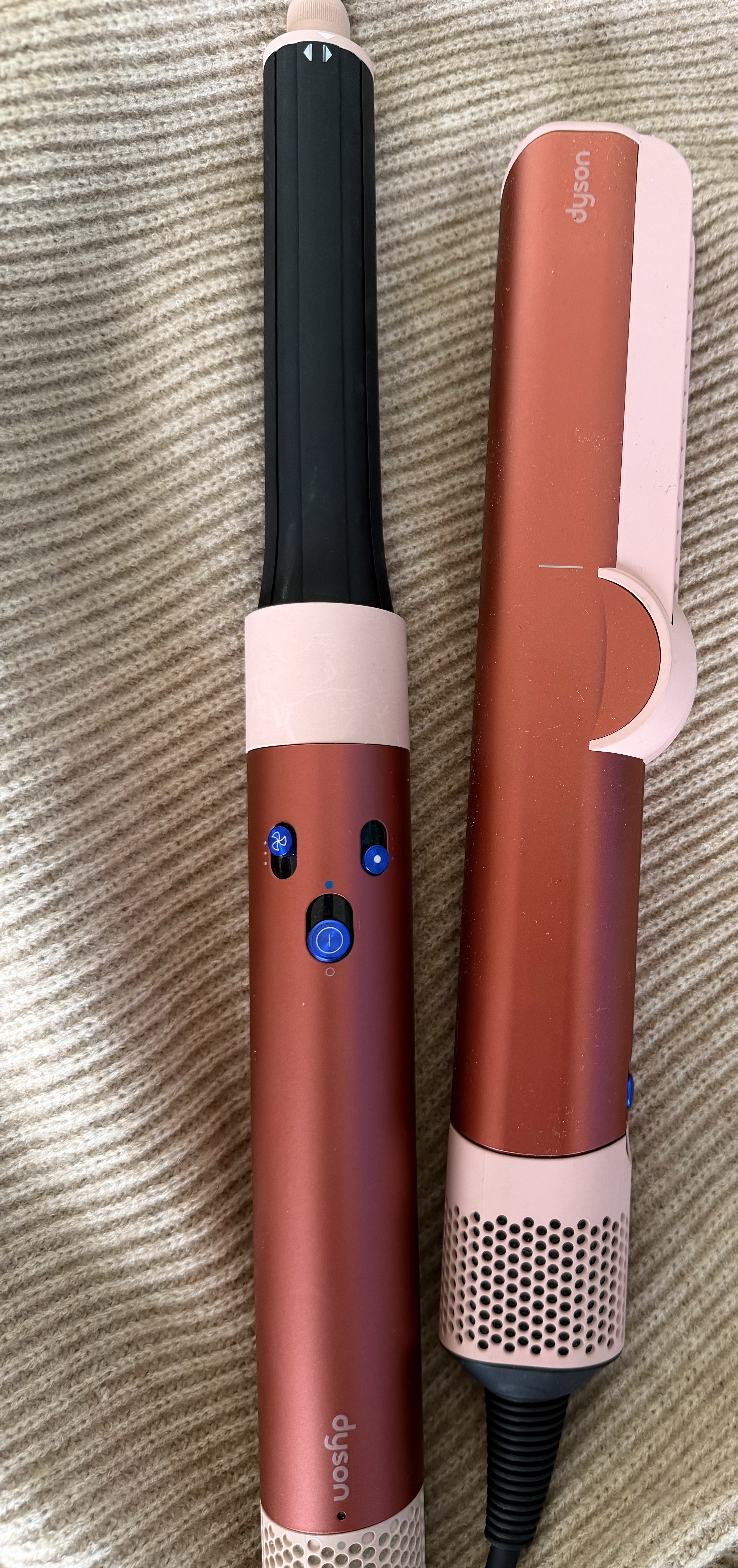
I put off buying either of these for a long time. Not because I doubted they worked, but because $400+ on a hair tool felt like the kind of purchase you research for months and still second-guess at checkout. I ended up owning both. I’ve had my Airwrap Complete Long for over a year now. About two weeks after I bought it, Dyson released the newer ID version, and since then they’ve also come out with the Coanda x2 with a larger round brush. Honestly, the version I’d actually consider upgrading to is only if I ever move somewhere with a different voltage where my current devices stop working.
I have 2c/3a hair and I live somewhere humid, which turns out to matter more than almost anything else in this comparison. So here’s the honest breakdown, based on actually using both for a while, not a first-week review.
They are not solving the same problem
This is the part most comparisons skip past too quickly. The Airwrap and the Airstrait are not two versions of the same tool. They’re built for opposite hair goals, and for me, they’ve ended up serving genuinely different purposes rather than one replacing the other.
The Airwrap uses air to shape hair around barrels instead of clamping it with heat plates, which is why it does less damage than a traditional curling iron while still giving real curl, wave, or volume. The Airstrait dries and straightens straight from soaking wet hair in one pass, which is a different category of tool entirely.
How I actually use each one
Honestly, I don’t reach for the curling barrels on the Airwrap much. I’m a large-brush girl. If I want my hair done fast, I use the smoothing brush attachment, and I also picked up the wide-tooth comb brush, which cuts the time down even more. The Airwrap is my lazy-day tool. Quick, low effort, and it still looks intentional.
The Airstrait is where the humidity math comes in. My hair sponges up and loses its shape faster with the Airwrap in this climate. The Airstrait’s results just last longer for me. And here’s the part that surprised me: my bounciest, most effortless curls don’t come from the Airwrap’s barrels at all. They come from styling with the Airstrait, putting my hair in a bun, sleeping in a satin bonnet, and waking up to soft, healthy curls the next morning. It’s a straightener that indirectly gives me better curls than the curling tool.
For humid climates specifically, if I had to pick the one that’s the better investment for actually holding up, it’s the Airstrait for me.
The unglamorous part nobody mentions
Both tools work better with the right supporting cast, and it’s not just the tool itself doing the work. My non-negotiables: a satin bonnet, satin hair ties, alligator clips for sectioning, a comb brush, the AC on, and patience. None of that is optional if you actually want the results you see in the tutorials.
I’ll also say plainly: since getting these tools, I’ve started spending more on the products I use with them, and between the tools and the products, my hair genuinely looks healthier and shinier than it used to. That’s part of the cost of entry that doesn’t show up in the tool’s price tag. You can see my current hair product picks on my finds page.
The honest verdict
If your hair goal is curls, waves, or volume and you want something fast for regular, low-effort days, the Airwrap earns its price, especially with a brush attachment instead of the barrels if you’re not a curl-barrel person either.
If you’re in a humid climate, have textured hair like mine, and want results that actually last, the Airstrait is the better investment, and don’t sleep on the overnight-bun-and-bonnet method for curls you didn’t expect a straightener to give you.
Trying to do both regularly is the only case where owning both genuinely makes sense, and for me, it does. I use them for different purposes and honestly think they’re both worth it. But if I had to keep just one for my hair type and my climate, it’s the Airstrait.
If you already own one (or you’re deciding based on how you’d actually use it), I broke down my full routine for each: my Airwrap routine, start to finish, and my Airstrait routine, including the overnight trick that gives me better curls than the Airwrap’s own barrels.
If I do end up moving somewhere that forces a voltage change and I pick up the Coanda x2, I’ll come back and update this post with how it actually compares.
Some links in this post are affiliate links. I only link products I actually use.
Free for Collective subscribers
The 90-Day Content Blueprint
The exact planning framework I use to map out a full quarter of content — pillars, topics, repurposing, and tracking. Free for Collective subscribers.
No spam. Unsubscribe anytime.